Employment Rights Bill 2025: what employers need to know and how to prepare

The Employment Rights Bill 2025 represents one of the most significant overhauls of UK employment law in a generation. Following months of parliamentary debate and “ping-pong” between the House of Commons and the House of Lords, the Bill has now been formally approved by the Lords and is approaching its final stage.

The only step remaining before the Employment Rights Bill 2025 becomes law is Royal Assent, which is expected before Christmas, although the exact date has not yet been formally confirmed. Once Royal Assent is granted, the Bill will become an Act of Parliament, but crucially, this does not mean all changes will take effect immediately.

For employers, this period is not one to wait and see, but an opportunity to prepare.

What happens next with the Employment Rights Bill 2025?

Once Royal Assent is confirmed and the final Act is published, we will gain clarity on:

  • Which provisions of the Employment Rights Bill 2025 take effect immediately
  • Which changes have fixed future implementation dates
  • Which will be introduced later through commencement regulations

This staggered approach means businesses will need to stay informed and flexible, as new obligations may apply at different times rather than all at once.

Key changes introduced by the Employment Rights Bill 2025

While full details and timelines are still being finalised, the Employment Rights Bill 2025 introduces a number of headline reforms that will significantly increase compliance obligations for employers.

Changes to unfair dismissal rights

One of the most impactful aspects of the Employment Rights Bill 2025 is the proposed reduction in the qualifying period for unfair dismissal claims. This would allow more employees to bring claims earlier in their employment, placing greater importance on fair recruitment decisions, structured probation processes and well-documented performance management from day one.

Zero-hours contracts and predictable working patterns

The Employment Rights Bill 2025 introduces new rights aimed at providing workers with more predictable working hours. While the precise scope and application of these measures will be confirmed through later regulations, employers who rely on variable or flexible staffing models should begin reviewing how working hours are offered and managed.

Fire and rehire: stronger safeguards

Dismissal and re-engagement practices are also being tightened under the Employment Rights Bill 2025. Employers will be expected to demonstrate genuine consultation, explore alternatives and follow strengthened procedural safeguards before considering fire-and-rehire strategies. Poor handling in this area could expose businesses to both legal and reputational risk.

Expanded harassment prevention duties

Another key feature of the Employment Rights Bill 2025 is the expansion of employer duties to prevent harassment. This includes clearer expectations around proactive prevention and protection from third-party harassment, such as from customers or clients. Policies alone will no longer be enough; employers will need to show meaningful action through training, reporting mechanisms and workplace culture.

Sick pay, family leave and day-one rights

The Employment Rights Bill 2025 also widens access to statutory sick pay and family-related leave, with more day-one rights for employees. While implementation dates are still to be confirmed, employers should anticipate updates to policies, payroll systems and manager guidance once the timetable is published.

A new Fair Work Agency

To support enforcement, the Employment Rights Bill 2025 creates a new Fair Work Agency. This body will have powers to enforce employment rights proactively, signalling a move towards increased oversight rather than relying solely on individual employee claims.

What should employers be doing now?

Although not all provisions of the Employment Rights Bill 2025 are in force yet, there are practical steps businesses can take now to reduce risk and avoid rushed changes later:

  • Review contracts, policies and procedures
  • Train managers on fair process, consultation and documentation
  • Identify higher-risk areas such as dismissals, working hours and harassment
  • Budget for potential cost increases linked to compliance

For many organisations, especially smaller employers, navigating these changes alone can be challenging.

How our HR support can help your business prepare

Access to the right HR support can make a significant difference when dealing with major legislative change. Whether through ad hoc HR support for specific issues or retained HR services for ongoing compliance, professional guidance can help ensure changes are implemented correctly and proportionately.

Working with an experienced HR consultant allows employers to understand what the Employment Rights Bill 2025 means in practice for their specific business, rather than relying on generic advice. This is particularly valuable for companies seeking practical, proportionate HR advice for small businesses, where resources and internal expertise may be limited.

How Blue Tree HR Solutions can support you

Once Royal Assent is confirmed and the full implementation timetable for the Employment Rights Bill 2025 is published, Blue Tree HR Solutions will review exactly:

  • What applies to your business
  • When it applies
  • What practical steps you need to take

Whether you need one-off guidance or ongoing support, our retained HR and ad hoc HR services are designed to help businesses remain compliant, confident and prepared as employment law continues to evolve.

If you would like tailored advice on how the Employment Rights Bill 2025 may affect your organisation, please get in touch with Blue Tree HR Solutions for expert support.

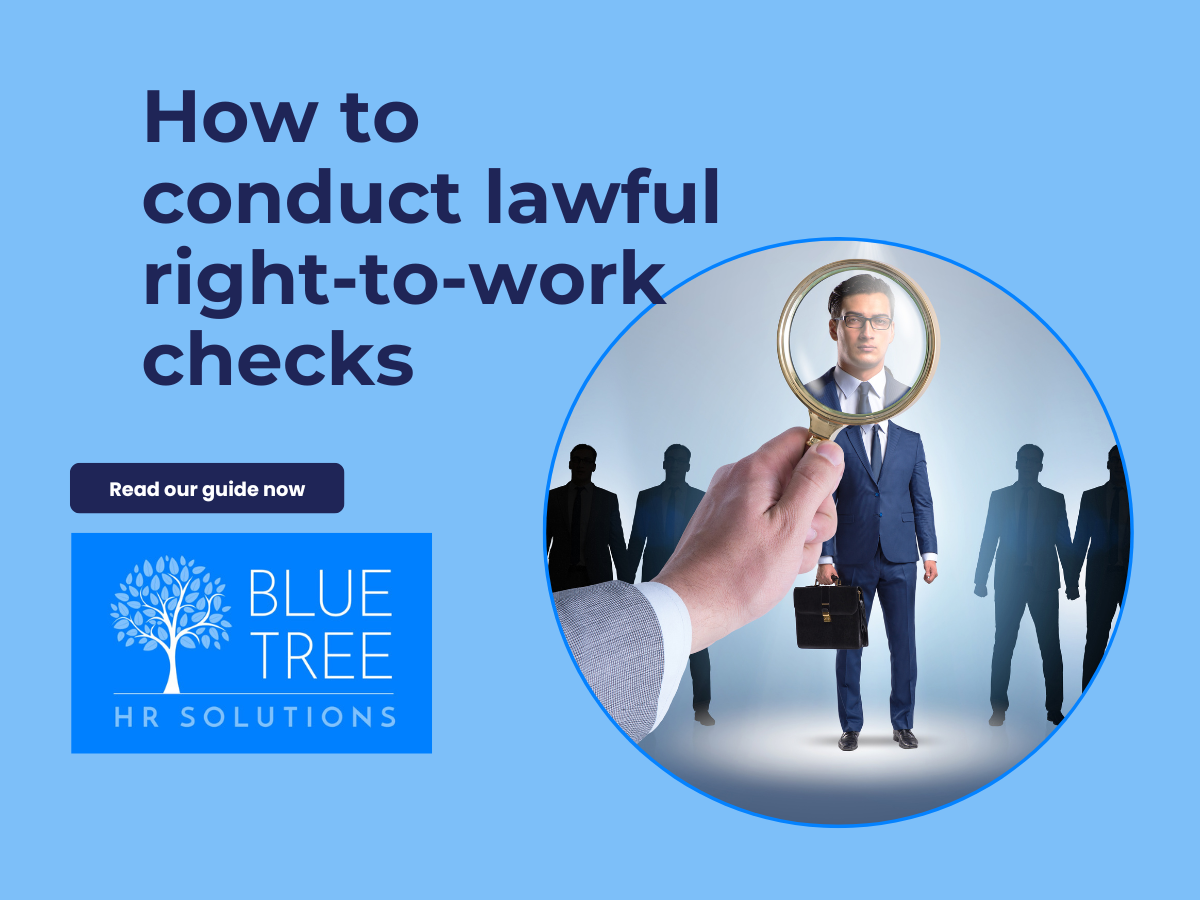
Right To Work Checks – Employers Guide

How to Conduct Lawful Right To Work Checks

If you’re hiring someone new, before they start, you need to make sure that they have the legal right to work in the UK.

A quick check at the right time can save you from fines, tribunals and major disruption later on.

Here’s our step-by-step guide to conducting lawful right-to-work checks.

The 3 ways to check right to work

The law gives you three different ways to check someone’s right to work. Which one you use depends on the person you’re hiring:

  • For most people, a manual document check is still the standard option.
  • If they’re a British or Irish citizen with a valid passport, you can choose to use a Digital Verification Service instead.
  • If they have a digital immigration status (eVisa), you’ll need to use the Home Office’s online service with a share code.

Each method has its own steps, but whichever you choose, you must follow it exactly to protect your business from liability.

  1. Manual document check

This is your hands-on approach and it has to be done properly to count.

You need to:

  • Obtain original documents from the person, choosing from the government’s List A (permanent right to work) or List B (time-limited right to work).
  • Check that the documents are genuine and belong to the person. This must be done in their presence, either face-to-face or over a live video call, while you hold the originals. Look carefully at:
    • The photo and date of birth: do they match the person in front of you?
    • Expiry dates: has the document or visa run out?
    • Work restrictions: are there limits on the type of work or hours?
    • Name differences: if names don’t match across documents, ask for evidence (e.g., a marriage certificate) and keep a copy of this supporting document
  • Copy and keep the documents in a format that can’t be altered (e.g., PDF or JPEG). Record the date of the check clearly. Keep the copy securely for the whole period of employment plus two years, then destroy it safely.
  1. Digital Verification Service (DVS)

If your new hire is a British or Irish citizen with a valid passport (or Irish passport card), you can use a Digital Verification Service to prove their identity and right to work. It’s quicker than a manual check because the provider verifies the passport digitally.

But here’s what to know:

  • This only works for British and Irish passports, no other nationalities.
  • You must choose a provider that meets government standards, otherwise the check may not be valid.
  • Even if you use a provider, you’re still legally responsible for getting it right. If something goes wrong, the liability is yours, not the provider’s.
  • You must keep a copy of the check for the length of employment plus two years, just as you would with a manual check.
  • You still need to check that the person in front of you (in person or via video call) matches the photo and details provided.

Used correctly, DVS is a fast, secure way to check passports. But the responsibility always stays with you, as the employer, that you have conducted the check correctly.

  1. Home Office online check

For many workers, especially those with an eVisa or digital immigration status, the Home Office online service is the only valid way to check right to work. The process is simple, but there are rules you need to follow:

  • The worker generates a share code online and gives it to you, along with their date of birth.
  • You must enter these details yourself on the government’s official service (“Check a job applicant’s right to work”), it’s not enough to look at what the worker shows you on their screen.
  • The system gives you a profile page with the person’s photo and details of their permission to work. You must check that the person in front of you matches that photo (either in person or via video call).
  • If the worker has restrictions, such as limited hours, these will be shown. You can only employ them within those conditions.
  • You must download or print the profile page and keep it securely for the whole period of employment plus two years afterwards.

This online system is the only way many people can prove their status now, as physical documents, like Biometric Residence Permits, are being phased out.

When to use the Employer Checking Service (ECS)

In some cases, you won’t be able to complete a manual or online check, for example, if someone has an outstanding Home Office application, appeal or their digital status isn’t available.

In these situations, you can ask the ECS to confirm whether the person has the right to work. If they do, the ECS will issue you with a Positive Verification Notice, which gives you a statutory excuse for six months.

Understanding document lists

When you carry out a manual check, the law sets out two official lists of documents you can accept.

  • List A covers people with a permanent right to work in the UK. If their documents are from this list, you don’t need to check again.
  • List B covers people with a temporary right to work. If their documents are from this list, you’ll need to do a follow-up check when their permission is due to expire.

List A: Permanent right to work

These documents mean no follow-up checks are needed.

Examples include:

  • A current or expired British or Irish passport
  • A UK birth or adoption certificate plus a National Insurance number

Once you’ve checked these properly, your responsibility ends there.

List B: Time-limited right to work

These documents have an expiry date.

Examples include:

  • A current passport showing a visa with time-limited permission to stay
  • A biometric immigration document that allows certain types of work

For these, you’ll need to do a follow-up check on or before the date that their permission expires to keep your statutory excuse.

Compliance and common mistakes

Most business owners need to watch out for:

  • Expired Biometric Residence Permits
  • Inconsistent checks across the team
  • Forgetting follow-up checks for time-limited visas
  • Irish citizens needing specific documentation
  • EEA citizens requiring proper UK immigration status
  • Accepting invalid or expired documents

Your essential compliance checklist:

  • Check documents before day one
  • Record the actual date the check was carried out
  • Keep dated copies securely for the duration of employment plus two years
  • Set calendar reminders for follow-up checks on time-limited visas
  • Apply checks consistently to everyone, including British citizens
  • Destroy documents securely after the retention period

The risks of getting it wrong

Miss these checks and you could face:

  • Fines of up to £60,000 per illegal worker
  • Potential criminal prosecution
  • Possible imprisonment of up to 5 years
  • Business closure notices
  • Loss of sponsorship rights

Discrimination matters

One crucial rule is to apply checks exactly the same for everyone. This includes British citizens, don’t assume anyone is exempt.

No assumptions based on:

  • Name
  • Accent
  • Appearance

Let’s make this simple

Immigration rules change quickly and the details can be hard to track.

If you’re not sure whether your current process is watertight, it’s worth getting an expert view before it becomes a problem.

Book a 30-minute check with us. We’ll:

  • Review your current hiring process
  • Spot potential risks
  • Give you a clear, actionable plan

Important: This guide contains general advice. Always check the specific details for your situation with an expert.

What to do when a new hire isn’t working out during probation

What to do when a new hire isn’t working out during probation

What to do when a new hire isn’t working out during probation

You hired someone promising. Three weeks in, your gut’s telling you something’s off.

Probation exists for exactly this reason but handling it fairly while protecting your business can be tricky.

What probation actually means

Probation isn’t a legal requirement. It’s a contractual trial period where you can use shorter notice periods (typically one week instead of a month) and may withhold contractual benefits, like private healthcare, depending on your contract terms.

Your new employee still has statutory rights from day one: minimum wage, holiday pay and protection from discrimination. These apply regardless of probation.

How to manage probation properly

Set clear expectations from the start

Give your new hire a proper job description with specific, measurable goals for their first three months.

Tell them your standards and what doing a good job looks like in your business.

Get the basics right

A proper induction sets them up to succeed. Show them how you work, introduce the team and schedule essential training.

If they struggle after you’ve done everything right, the issue is unlikely to be your onboarding.

Review regularly and keep notes

Have weekly check-ins at first, then monthly once settled. Document discussions, progress and agreed actions.

Send summaries afterwards so everyone’s clear. Address problems immediately with specific feedback.

Give them a chance to improve

When someone’s struggling, identify why. Often small adjustments work: extra training, clearer instructions or different working arrangements.

Ask what would help, they might have solutions you haven’t considered.

When things still aren’t working

Consider extending probation

If you need more time to decide, you can extend probation, usually by a month. Put it in writing, explaining why and what they need to achieve.

Extensions are only valid if your employment contract allows for them. Avoid multiple extensions.

If you need to dismiss

Sometimes it doesn’t work out. You still need to follow a fair process: meeting in writing, explain reasons, let them respond, confirm decision in writing, offer a right to appeal.

This reduces the risk of discrimination or automatic unfair dismissal claims, which employees can bring even with less than two years’ service.

Consider upcoming changes

Proposed changes in the Employment Rights Bill could introduce day-one protection from unfair dismissal, with many changes expected to phase in from late 2026 into 2027. Details are still subject to Parliament and consultation.

Either way, tightening your probation process now is a smart move. Document your approach, train managers on reviews and get comfortable with timely talks about how people are doing.

Making probation work for you

Good probation management is straightforward: set clear expectations, review regularly, document everything and act on problems quickly.

Not sure if your probation process would stand up to scrutiny? Worried about handling a failing probation?

Drop us a message for a confidential chat about protecting your business while treating people fairly.

Eco-friendly office initiatives for employee wellbeing

Gone are the days that corporate social responsibility (CSR) is just a tick box exercise. Sketch Studios uncovered that 24% feel their mental and physical health is impaired by a workplace that is not environmentally friendly. And if you have a large workforce, that’s quite a lot of unhappy staff!

Today, we’ll discover how sustainability drives wellbeing in the workplace, the role it plays in enhancing mental health and how you can implement an eco-friendly office initiative.

How Sustainable Workplaces Drive Wellbeing?

Just like how our home environment can impact how we feel, our working environment can too. Whether there’s too much noise, lack of ventilation, overcrowding and the like can cause a lot of friction in the workplace and negatively impact your staff’s productivity.

Here are some ways sustainable workplaces drive and affect wellbeing.

Improve indoor air quality

The British Journal of Psychiatry has proven that, in general, poor air quality can affect mental health. This also includes the workplace, and it’s up to organisations to ensure they have the right HVAC systems in place to provide quality, clean air.

Access to natural light

Natural light has an effect on our circadian rhythms, eye strain, mood, focus and concentration. Poor light levels can have adverse effects in the workplace, as uncovered by Workplace Insight. When asked about the main irritations with office illumination, issues cited included not being able to control the lights (34%), artificial light being too bright (33%) and discomfort due to sunlight glare (28%).

Flexible workspaces

To meet diverse needs in the workforce, it’s important to have flexible workspaces (bonus points if they’re made from sustainable materials). This is especially true if you have an open-plan office. Breakout areas and private meeting rooms allow staff to conduct independent working, or collaboration in small groups.

Green commuting initiatives

Corporate cycle to work schemes, electric vehicles, carpool initiatives, public transport passes – these are all examples of green commuting initiatives employers can offer to staff. They give employees the choice to commute in a way that suits their needs in a sustainable way.

Access to nature

Whilst it may not always be possible to have the best landscaping around your work premises, there is strong research to suggest indoor nature contact at work can significantly reduce work-related stress. Indoor gardens, desk and/or ceiling plants are just some ways to enhance your work environment and employee wellbeing.

The Role of Sustainable Workplaces in Enhancing Wellbeing

When thought has been given to building a sustainable workplace, you can enable positive mental and physical wellbeing for all. With 1 in 5 admitting work has been impacted by high levels of pressure and stress, employers need to do more to lessen work-related stress and eventual burnout.

Here are just some of the ways sustainability plays a role in enhancing wellbeing in the workplace.

Promoting work-life balance

Organisations have that a  flexible working policy are in good stead for promoting work-life balance. This is because it gives employees more control over their schedules, allowing them to work when they’re at their best.

If you adopt and on-site working mode, this is still relevant. Proper lighting (especially access to abundant natural light), ergonomic work desks and access to employee assistance programmes (EAP) are just some ways you can contribute to the happiness of employees.

Employee engagement programs

Employee-driven workplaces empower your staff to lead projects and initiatives that benefit all. Whether that’s DE&I, charity fundraisers, peer-to-peer training, employee engagement programs allow staff to implement positive changes and influence one another for the better.

Social connections and community building

Community building in the workplace is important for mental health. After all, humans are naturally social beings. A sustainable workplace should recognise this and encourage teamwork and collaboration to build a sense of belonging. This could be through regular socials, team-building activities, prize initiatives and the like.

Noise reduction strategies

Whether you operate in a lively office or warehouse that uses heavy machinery, noise reduction strategies are crucial for employee mental health. Noisy offices can cause stress, particularly if it’s open plan. Offering noise-cancelling headphones and quiet working zones are just some ways you can mitigate this.

Steps to implementing

Now that we know how important eco-friendly office initiatives are for employee wellbeing, how do we actually apply them?

Leadership commitment

What happens up top trickles down, so you need to ensure leadership and management teams are well versed in the sustainable practices you’ve implemented in your workplace, and ensure they practice them through and through. Set clear goals for your initiatives and lead regular training sessions with your leadership team(s) to keep them accountable.

Employee involvement

Want to improve your CSR? Involving employees in the decision-making process is key. Run surveys and focus groups to really understand what employees are experiencing, as they’re the ones your sustainability efforts will affect the most. If your organisation already has an EAP or other wellbeing functions, it’s important you regularly encourage your employees to use them not just because they’re perks, but because it’ll boost their wellbeing in and out of work.

Implement green practices

According to People Management, prospective job candidates are scrutinising sustainable practices when making informed decisions about their next role. Do more than just adding a recycling bin in your office. Ensure you have other green practices such as waste-specific bins for plastics, mixed and general waste. It’s also important to shout about any initiatives that contribute to being a zero-waste company through your internal comms, press releases and job adverts.

Focus on employee wellbeing

To uphold a sustainable workplace, you’ll need to focus on employee wellbeing. Workstation assessments, mental health support, providing healthy snacks, and spaces for regular check-ins are just some ways you can do this as an employer. This can even extend to your office décor. If allowed, having natural greenery can help productivity levels and even aid in reducing work-related stress.

Measure and evaluate

Not all sustainable office implementations go to plan. That’s why it’s important to have goals you want to measure, and a way to evaluate their effectiveness on a regular basis. Perhaps you find that recycling bins aren’t being used properly because they aren’t properly signposted, or no one is using the one-to-one spaces you’re offering but would rather speak to someone impartial. For the latter, EAPs are incredibly handy, as they can provide mental health support from an outsider’s perspective with no bias.

Continuous improvements

You can’t just implement new processes and hope they stick. There’s always room for improvement, so use your evaluations to improve your sustainability goals. You can implement new wellness programmes, use technology to track your progress and gather regular feedback to see where bottlenecks are. Not only will this streamline your sustainability efforts, but it will show your employees you care.

EAP the employee benefit that your workforce wants and needs

If you’re an employer, you have a duty of care to your employees. And whilst it’s important you encourage openness in the workplace, sometimes certain stressors can get on top of us, which may not always be due to work.

An EAP can provide confidential legal, occupational and mental health services for employees as part of your wider corporate wellbeing programme. At HA | Wisdom Wellbeing – the UK’s leading provider – we believe in 24/7 support for all, as this ensures your employees have someone to talk to anywhere, anytime.

Plus, with a comprehensive EAP such as ours, your employees can benefit from our mental health first aid courses. This will equip them with the skills to create action plans to help their fellow colleagues and guide them toward professional help if needed.

Conclusion

From ‘green’, eco-friendly initiatives to wellbeing programmes – there’s a spectrum for what constitutes a sustainable workplace. A truly sustainable workplace must encompass everything that contributes to the wellbeing for all. Be it through office décor, recycling schemes, CSR and employee wellbeing.

After all, everything a business does must be in service of bettering its offering for a competitive advantage. That means ensuring your staff are well looked after, they practice your values and create an environment that attracts top talent


Stress awareness month: the true cost of stress in the workplace

April is Stress Awareness Month, and the figures are impossible to ignore. Poor mental health is now costing UK employers a staggering £51 billion every year. Of that, £28 billion is due to stress-related absence and burnout. In the past year alone, more than 16 million working days were lost because of stress, depression or anxiety.

These numbers tell a powerful story. It’s one that’s playing out in businesses across the country. People are overwhelmed. Burnout is widespread. Stress is no longer a quiet issue hidden beneath the surface. It’s a serious and costly problem that needs to be addressed.

Behind the statistics are people

We talk a lot about productivity, profit, and performance, but at the heart of every business are people and when people are struggling with stress, everything else begins to unravel.

That’s why Stress Awareness Month is more than just a date on the calendar. It serves as a timely reminder that businesses have a responsibility. This responsibility is not only to acknowledge stress but to actively address it. You can learn more about the national campaign on the International Stress Management Association’s Stress Awareness Month 2025 website.

Stress isn’t always caused by what’s happening outside of work. In many cases, it comes from within the workplace itself. It might be unmanageable workloads, unrealistic expectations, poor leadership, a lack of support, job insecurity or a toxic team culture.

The longer these issues go unaddressed, the more damage they cause. This includes financial loss, lower morale, damage to reputation, and long-term instability.

It’s time to ask the tough questions

Marking Stress Awareness Month shouldn’t just involve sharing infographics or motivational quotes. It’s an opportunity to pause and reflect. Are we doing enough to support our people? Are we unintentionally contributing to their stress? What needs to change?

Effective well-being strategies are based on real understanding, not assumptions. They come from honest conversations, from listening to your team, and from looking at what’s really going on. For example, when was the last time your staff felt able to speak openly about their workload? Do your managers recognise the signs of burnout? Have you created an environment where honest feedback is welcomed?

These are the kinds of questions we regularly help businesses explore through our ad hoc HR support. When challenges are approached with focus and care, even small changes can lead to long-term improvements.

Quick fixes won’t cut it

Offering a mindfulness app or the occasional free lunch might seem helpful, but if the root causes of stress aren’t being tackled, those gestures won’t make a lasting difference.

Stress Awareness Month is a chance to take a closer look at your workplace. Are workloads fairly distributed? Are your managers equipped to lead well? Do your people feel safe and supported?

Supportive leadership doesn’t require perfection. It means being present, approachable and clear. Managers who regularly check in, clarify expectations and lead with empathy can make a huge difference to team wellbeing.

In many cases, this is where retained HR support becomes incredibly valuable. It provides consistent, strategic guidance to help shape a healthier workplace culture that lasts far beyond April.

Supporting your people helps everyone thrive

Creating a healthier, more productive workplace is not just good for employees- it benefits the entire business. Lower absence rates, better engagement, improved retention and stronger performance all grow from a culture where mental health is taken seriously.

Recognise the problem this Stress Awareness Month

This Stress Awareness Month, take meaningful action. Whether you start by training your managers, reviewing policies or opening up space for honest conversation, every step counts.

If your business is ready to take employee well-being seriously and you’re looking for clear, compassionate support, we’re here to help. We offer straightforward and effective HR advice for businesses that want to make a positive change.

If you’d like to talk about how we can help, contact us for HR support today.

Blue Tree HR Newsletter February 2025

February 2025 News

HR Policy Checklist for 2025

I can’t stress enough how important policies are. They are your business’s instruction manual and ensure that you…

• Stay legally compliant
• Set clear expectations
• Act consistently and fairly
• Protect you and your business

And with the new laws that Labour are introducing, it’s vital to make sure you have the right policies in place.

Do you have the right policies in place for 2025?

The Chartered Institute of Personnel and Development (CIPD) provides comprehensive guidance on HR policies that UK businesses should consider implementing.

While some policies are legally required, others are recommended to promote best practices and align with organisational objectives.

Here are the policies you legally need to have:

Health and Safety Policy: This policy is mandatory for organisations with five or more employees and outlines the company’s commitment to maintaining a safe working environment.

Disciplinary and Dismissal Policy: Employers must have clear procedures for managing employee misconduct and performance issues.

Grievance Policy: A grievance policy provides a structured process for employees to raise concerns or complaints about workplace issues, ensuring that they are addressed promptly and fairly.

For a full list of policies you SHOULD have, please get in touch with us today.

Race Discrimination claim upheld

manager and staff worker in open conversation - Blue Tree HR Solutions custom HR solutions

A recent tribunal ruling on race discrimination at a Norfolk hotel serves as a stark reminder of the importance of building a truly inclusive workplace.

Despite reporting incidents, management failed to investigate a staff member’s concerns about racist remarks adequately, leading to claims of institutional racism. This has resulted in legal repercussions and damage to the organisation’s reputation.

A robust anti-discrimination policy could have prevented this. Managers should also have received training on how to handle complaints appropriately and on how to foster a culture where employees feel respected and heard.

https://www.hrmagazine.co.uk/content/news/tribunal-backs-hotel-receptionists-race-discrimination-claim

The key to successful coaching

Coaching can be a transformative tool for personal and professional growth, but it only works when all parties are ready and willing to engage.

As Clare Norman highlights in this article, assessing “coachability” is critical. Employees must be open to change, think proactively, and prepare for the process. For small business owners, ensuring that coaching is the right fit at the right time can significantly improve outcomes.
If you’re considering coaching for your team, let’s discuss how to set the stage for success.

https://www.peoplemanagement.co.uk/article/1897260/why-coaching-works-parties-board

Sexual misconduct reports surpass malpractice disclosures

Research by whistleblowing platform, SafeCall, found that 70% of employees are likely to report sexual misconduct or bullying, compared to lower rates for issues like data misuse (56%) and unfair treatment (53%). It also found that younger workers are less likely to report misconduct than older colleagues.

This emphasises the need for clear reporting policies, transparent workplace cultures and leadership commitment, to encourage a safe environment for addressing all types of misconduct.

https://www.hrmagazine.co.uk/content/news/employees-more-likely-to-report-sexual-misconduct-than-malpractice

4 ways to make your employees LOVE working for you

Creating a workplace where people feel valued and motivated isn’t just good for your employees; it’s great for business, too!

Here are four key ways to build an environment where people love to work:

1️⃣ Recognise their efforts

A simple “thank you” or acknowledgement of a job well done can go a long way. Celebrate big and small wins to show appreciation for their hard work.

2️⃣ Develop growth opportunities

Provide clear paths for career development. Whether it’s training, mentorship or promotions, employees need to know that they can grow with you.


3️⃣ Prioritise work-life balance

Respect boundaries, offer flexibility and create policies that support mental and physical well-being. Happy employees are productive employees!

4️⃣ Show that you care

Take an interest in their well-being, both at work and outside of it. A little empathy and understanding can make a huge difference.

Get in touch if you would like to improve the performance and engagement of your employees.

Q&A

What should I do if an employee fails to attend a disciplinary hearing?

First, you should make reasonable efforts to reschedule. If the employee repeatedly fails to attend without a valid reason, you can make a decision based on the evidence you have available. Before deciding, you will need to consider company policy, the employee’s record, reasons for absence and medical opinions. It’s best to contact an expert for guidance. We can help.

Do apprentices have the same rights as employees?

Apprenticeships are a great way to get work experience while training and studying for qualifications. They have the same rights as those legally classed as employees. However, there is a separate National Minimum Wage rate for apprentices.

My employee has been sick for 4 days, do they need a fit note?

If someone is off sick for 7 calendar days or less (including weekends), they do not need a fit note. They can tell you they’re not well enough to work without medical evidence and should still be paid the amount of sick pay they’re entitled to.

HR support for small businesses: A cost-effective solution for compliance and efficiency

2024 went by fast and in 2025, we are all about saving you and your small businesses time!

At Blue Tree HR Solutions we understand the complexities and struggles in regards to HR support for small businesses. And we as a team understand the importance of compliance regulations and the headache that comes with the time-consuming administration within small companies. Whether retained HR services are required or an ad hoc HR consultant is necessary, we treat every client and issue with the utmost importance and security.

Hopefully using this blog we will give you a greater understanding of what we can offer, in terms of HR support for small businesses. And how we can assist with every HR question, advice or documentation. Small businesses are the heart of our business and we believe the people are what makes them so amazing to work for.

Whether via phone, email or face-to-face meetings, at Blue Tree HR Solutions, we are here to offer flexibility to your every HR need!


Compliance risks

As experts in HR support for small businesses, with over 20 years of experience and a consistently high-performance history, we understand the significant importance of accuracy when following compliance regulations.

Whether using us as a freelance HR consultant, for advice on accuracy or the development of documents, or using us as a retained member for all HR requirements. We will ensure all provisional contracts and documents are formed with accuracy and follow all requirements necessary. While also ensuring that matters of grievance and disciplinaries are followed with insurance of legality and ethics while supporting management through communication and advice.

Time consuming tasks

At Blue Tree Hr Solutions we offer the alternative of outsourcing HR whether the job is big or small, we take things off your hands and ensure that you can save yourself valuable time and effort. Whether a one-time use, occasional use or full-time HR management, we take the time to dot the I’s and draw the T’s.

As a freelance HR consultant, this often allows a more cost-effective alternative to an in-house HR department, we offer one-time uses and freelance HR support for small businesses, with expertise in advice and the provision of policies.

Limited resources

As a versatile company that works with a variety of companies of a variety of sizes, we understand that some small businesses may not have the budget or workforce to dedicate to an internal department of HR. This is how we, as a company, can offer HR support for a small business, with a freelance HR consultant, we’re able to offer flexible services on your terms, leading to a more cost-effective solution.

We understand that it is easy for a small business to become overwhelmed with the string of HR documentation and evolving compliance laws. We offer a solution that allows your company to be focused on your needs, whilst we take care of HR support and ensure complete accuracy and time-saving flexibility.

Expertise

With over 20 years of experience and heavy expertise in HR support for small businesses, we’re able to offer you our knowledge and understanding with any HR query you may have. From employee handbooks and policies to supporting management and recruitment onboarding, we’re able to offer a cost-effective solution to the standard in-house departments that a small business may not have the resources to offer.

Not only are we cost-effective and versatile, but we also enable your company to take control of your valuable time and ensure that you retain accurate and in-depth knowledge when needing advice and support.


Contact us for expert HR support for small businesses

If you would like more information on why our services are important for your business, check out our blog on “Why is HR advice for small businesses important?” For more information on our services, contact us now.

Blue Tree HR Newsletter January 2025

January 2025 News

The employer's checklist for 2025

Happy New Year!

It’s 2025, and it’s time to make sure your house is in order.

We’ve created a new checklist that will guide you through the top 10 areas you should be looking at to get the very best out of your team and business this year.

Including legal compliance, HR technology and the entire employee life cycle.

Here are the top 10 areas you should be looking at:

1. Make sure you stay legally compliant
2. Leverage HR technology to save time and costs
3. Attract the best people with a great employer brand
4. Find the right people with a legally compliant recruitment process
5. Give new starters a great onboarding experience
6. Retain your team and keep them happy
7. Invest in your team’s performance and your company’s success
8. Say goodbye to employees in the right way
9. Avoid dodgy Glassdoor reviews
10. Get strategic support from an independent HR consultant

You will find the full checklist on our website.

https://bluetreehrsolutions.co.uk/the-employers-checklist-for-2025/

Brits will spend 25 years of their life looking at a screen…

Here’s a stat that might make you want to turn off your laptop and hide your phone: A study has found that Brits will spend a staggering 25 years (that’s 223,015 hours!) in front of their screens over their lifetime.

Excessive screen time can impact health and cause symptoms such as headaches, eyestrain and poor sleep. So, it’s no surprise that people are being warned to cut back. From setting screen-free boundaries to savouring phone-free social moments, it’s time to discover how to reclaim our time and well-being.

https://hrreview.co.uk/hr-news/future-of-work-hr-news/brits-set-to-spend-25-years-of-their-lives-working-on-screens/376383

Is alcohol abuse quietly undermining your workplace?

With 17 million days lost annually to alcohol-related sickness, it’s an issue no employer can afford to overlook. Whether it’s a casual tipple or excessive consumption, some employees, especially those in high-stress or manual roles, are more vulnerable.

This highlights why preventive and supportive measures are crucial for all organisations. We can help you to navigate these issues.   https://hrzone.com/alcohol-abuse-in-the-workplace-spot-the-signs-and-support/

Leader and manager development is the HR industry's biggest priority for 2025

A Gartner report (a leading research and advisory firm) has found that leader and manager development will remain the priority for HR leaders worldwide in 2025.

The report highlights the increasing pressures on managers. It states that 75% of managers struggle to cope with their responsibilities, with only 36% feeling that their organisation’s current management training programmes effectively prepares leaders for the future.

This makes us ask: How prepared are your managers to lead your team this year?

You know what they say… people don’t leave bad jobs; they leave bad managers.

Bad management poses HUGE risks to your business, including:

• High staff turnover and low employee retention
• Decreased employee engagement and productivity
• Higher risk of being taken to an employment tribunal

What’s the solution to this?

You guessed it… Management training.

Management training can also be a great way to recognise the excellent management competencies that your managers already possess through formal acknowledgement and accreditation.

93% of young people in the UK have encountered negative treatment at work because of their age. This has increased from 88% just 3 years ago. Sadly, 26% of those who reported age-based discrimination said it led them to lose interest in working altogether. All young people deserve a pathway to success, so it's really important to bridge generational gaps and create a more inclusive workplace.

Q&A

Should I be conducting exit interviews?

It’s not a necessity, but it could help you to learn a lot. You may learn about competitor practices. You may gain valuable feedback and identify training or manager gaps, which may help you to discover a problem you didn’t know existed and allow you to fix anything that may reduce staff turnover.

How should I support employees who may be participating in Ramadan?

In 2025, Ramadan is expected to begin on Friday, 28 February and conclude on Sunday, 30 March. The exact dates depend upon the sighting of the moon.

Don’t make assumptions about who may be participating. Educate your managers, be flexible with working patterns and accommodate annual leave requests, where possible. It’s a good idea to talk to participating employees before Ramadan so that you can make reasonable adjustments.

Is it my responsibility to ensure employees use their holiday entitlement?

Ultimately, it’s a shared responsibility. Employees should plan their time off, but you, as an employer, must provide opportunities and encourage its use to comply with the law.

Practical steps include sending periodic reminders about holiday balances, ensuring you have a clear policy outlining how and when holidays should be taken and encouraging staff to book time off, especially if they are approaching year-end with unused entitlement.

Our top 7 best practices for inclusivity in the workplace over the holidays

With the holiday season here, many are looking forward to the celebrations that are ahead. However, it is important to also recognise that not everyone celebrates Christmas. Particularly this time of year, you’ll want to ensure that there is inclusivity in the workplace so that everyone feels valued and respected regardless of their cultural, religious or personal practices and beliefs.
Inclusive holiday celebrations can greatly impact team morale, strengthen bonds and ensure that everyone feels part of the celebration. Our expert HR services and solutions can help you create inclusive workplaces that your team will appreciate.

Why inclusivity in the workplace is important during holiday celebrations

At Blue Tree HR Solutions we understand that workplaces include people from different cultures and religious backgrounds as well as personal beliefs. While traditional holiday celebrations can be great and meaningful for some, they can unintentionally alienate or exclude some employees. By taking an inclusive approach to this holiday season and leveraging HR services and solutions, you’ll be able to ensure that everyone feels valued and included. In this blog, we’ll explore our 7 top ways to make your workplace festivities thoughtful and welcoming for everyone.

1. Go seasonal and neutral with the decorations

One simple consideration when it comes to the holidays is how you decide to decorate the office. With Christmas being a season based on Christianity, some decorations that are religiously themed may alienate members of staff. By choosing decorations that are non-religious and perhaps more seasonal you can go for a theme that everyone enjoys. You could also ask employees to suggest ideas for creating a festive atmosphere that resonates with everyone.

2. Use inclusive language

To increase inclusivity in the workplace, simple changes like saying ‘Happy Holidays’ rather than referring to specific traditions can make a difference in how people feel about seasonal greetings.

3. Recognise other holidays

If you have staff members who celebrate other holidays, why not make space to celebrate or acknowledge other cultural and religious holidays too? This could be a brilliant opportunity for your members of staff to learn about other holidays that are different to their own and encourage inclusivity in the workplace.

4. Accommodate dietary needs

When it comes to seasonal parties, there’ll often be meals planned or snacks offered as part of the celebrations. It’s important to consider all dietary restrictions, preferences and allergies so that no one feels left out.

5. Offer alcohol-free options

With many people preferring not to drink alcohol for a variety of reasons including religious reasons, or even if they’re driving, by hosting celebrations that offer non-alcohol options for drinks you will ensure that everyone feels welcomed.

6. Establish guidelines for respectful behaviour

By letting staff know what kind of behaviour is expected at office parties you can ensure a positive experience for everyone. This can be achieved by engaging employees in the planning process to understand what works best for your team to promote inclusivity in the workplace.

7. Celebrate end-of-year achievements

You could take the end of the year as a time to celebrate the accomplishments of the team and express gratitude for everyone’s contributions. By recognising your team’s efforts, you can create a supportive environment that makes staff feel valued and appreciated.

Making the holidays bright for everyone

The holiday season is a great time to celebrate and it’s also a brilliant time to bring your team together and thank the unique individuals who make up your workspace for their hard work throughout the year. By considering everything from decorations to communications used and the celebrations themselves, you can make sure that no one feels left out. By creating inclusivity in the workplace, you respect the diversity of your team and create a workspace that is connected and has a sense of togetherness.

Contact us if you need help making your workplace inclusive

We hope you’ve enjoyed reading our blog on inclusivity in the workplace, over the holidays. You may also want to read our manager’s guide to a fun Christmas at the office for more tips on keeping the office enjoyable for all but also respectful this time of year.
If you would like any more information or to get in touch with us regarding HR services and solutions, you can contact us for support and we’ll be happy to help. We offer expert HR solutions, retained or ad hoc HR for small businesses across Essex.

Blue Tree HR Newsletter November 2024

Why should you care about your employees’ ‘engagement’?

‘Engagement’ is an umbrella term we HR consultants use to describe your employees’ enthusiasm, commitment and motivation towards their work and your business.

Their levels of engagement have a direct impact on their performance and your bottom line.

That’s why working on engagement within your business is really important.

Now, with all things HR, it can easily seem quite intangible. But there’s a really easy way to measure your team’s engagement.

Engagement metrics not only help us to understand how engaged your team are, but they also help us to create benchmarks and report on improvements in the future.

  • Employee satisfaction surveys:

These surveys provide insight into how employees feel about their work environment, management and overall job satisfaction.

  • eNPS (employee Net Promoter Score):

This metric gauges employees’ loyalty and willingness to recommend their workplace, clearly indicating overall engagement levels.

  • Turnover and retention rates:

Monitoring how often employees leave or stay with the company helps assess engagement.

Want to know how engaged your employees are? Get in touch with us for a confidential chat.

The 4-day week reboot

The traditional five-day work week, long seen as the standard, is increasingly viewed as outdated. Many attribute productivity problems to the rigid focus on hours and days rather than output and effectiveness.

A new 4-day week pilot project will launch this month, allowing companies to test the model along with other flexible working practices, such as flexible hours and nine-day fortnights. The results will be presented to Labour next year, with the hope that political support will grow for this shift in work culture.

It offers a potential solution to improve our work-life balance, increase productivity and make us happier and healthier.  But can it be a “one size fits all” answer for every business?

https://www.peoplemanagement.co.uk/article/1887098/employment-law-perspectives-four-day-week

HR Audit: An essential strategic tool for your business 

As an independent HR consultant, our primary goal is to work in your business’s best interests and help you to achieve your goals.

When we start working with you as a Strategic Partner, we need to understand how your business ticks, the risks it faces and the opportunities available to you.

And the most powerful tool we can use to help us do this is an HR Audit.

What is an HR Audit?

An HR Audit is a comprehensive review of your company through the lens of an experienced HR expert.

Once we understand your goals and what you’re trying to achieve, we follow a structured approach to look at what’s happening in your business.

What are the main benefits of having an HR Audit?

  • Peace of mind

We’ll ensure your company is legally compliant and protected against costly employment tribunal claims.

  • Data-driven decision making

HR can often feel intangible. That’s why we’ll create HR Metrics, report on them and create a RAG-rated priority list of actions we need to take to help you to achieve your goals.

  • Customised and cost-efficient support

Once we know what needs to be worked on, we can provide you with the best possible support and price to make it happen.

If you’d like to review your business’s relationship with its employees and create the best possible action plan, please get in touch with us for a confidential chat today.

Did you know…..82% of managers and workers who entered management positions had not received proper training and were identified as ‘accidental managers’. If not carefully managed, this can lead to low employee engagement, reduced productivity and a toxic workplace culture.

https://www.peoplemanagement.co.uk/article/1887801/two-five-employees-not-think-manager-trained-enough-survey-finds

Q&A

What’s the difference between banter and bullying?

Banter is all about light-hearted, playful teasing that’s mutual and doesn’t cross the line—everyone’s in on the joke and no one gets hurt. On the flip side, bullying is targeted, mean-spirited, and aims to upset or put someone down, often with a power imbalance in play. It keeps going even when the targeted person isn’t okay with it. The big difference? Banter respects boundaries; bullying doesn’t.

Can I force employees to use annual leave for Christmas when the business is closed?

Yes, you can require employees to use their holiday allowance when the business is closed, like at Christmas, but you’ve got to follow some rules. Check their contracts and give proper notice—usually, notice must be at least twice the length of the holiday. Just ensure you’re on the right side of the law, communicate it clearly and you’ll be good to go!

Do I have to offer flexible working?

You don’t have to offer flexible working, but employees can request it. As an employer, you’re legally required to consider these requests reasonably. Still, you can refuse if there’s a valid business reason, like impact on performance, extra costs or difficulty meeting customer demand. Ensure you handle requests fairly and follow the correct process to avoid issues.